
Mortgage Rates Just Crossed 7% — Here’s Why the 10-Year Treasury’s 19-Year High Took Them There

Just a week after the Federal Reserve’s first rate hike since 2023, the bond market delivered a second jolt: on September 23, 2026, the 10-year Treasury yield jumped 17 basis points to 5.12%, its highest level in nineteen years. Mortgage rates, which track the 10-year Treasury far more closely than they track the Fed’s own overnight rate, followed it higher — Freddie Mac’s weekly survey crossed 7% for the first time in well over a year, and daily rate trackers put the average 30-year fixed at roughly 7.26%–7.29% by September 24, the highest reading since May 2024.
What actually moved the market
The trigger wasn’t the Fed itself this time — it was a stronger-than-expected report on U.S. business activity, which S&P Global’s September data showed expanding at its fastest pace since July 2021. Input costs jumped alongside it, driven partly by rising energy prices: Brent crude surged more than 3% the same day, climbing back above $102 a barrel after a week of declines amid renewed Middle East tensions. Put together, hotter growth plus rising oil gave bond investors a reason to price in more inflation and more Fed tightening ahead — the odds of an October rate hike jumped to 71%, up from 55% just a day earlier.
That’s the pattern worth understanding: mortgage rates don’t move because the Fed raises rates. They move because of what the bond market expects the Fed to do next. A hawkish surprise on growth or inflation can push your rate up even between Fed meetings.
What it means for your rate
It’s worth separating two numbers here, because they get conflated a lot. Freddie Mac’s official weekly survey — the benchmark most lenders and economists cite — came out September 24 at 7.03% for the 30-year fixed, up from 6.95% a week earlier and 6.76% the week before that. The daily trackers showing 7.2%–7.3% reflect the market’s real-time move after the Treasury spike, which the weekly survey hadn’t fully caught up to yet.
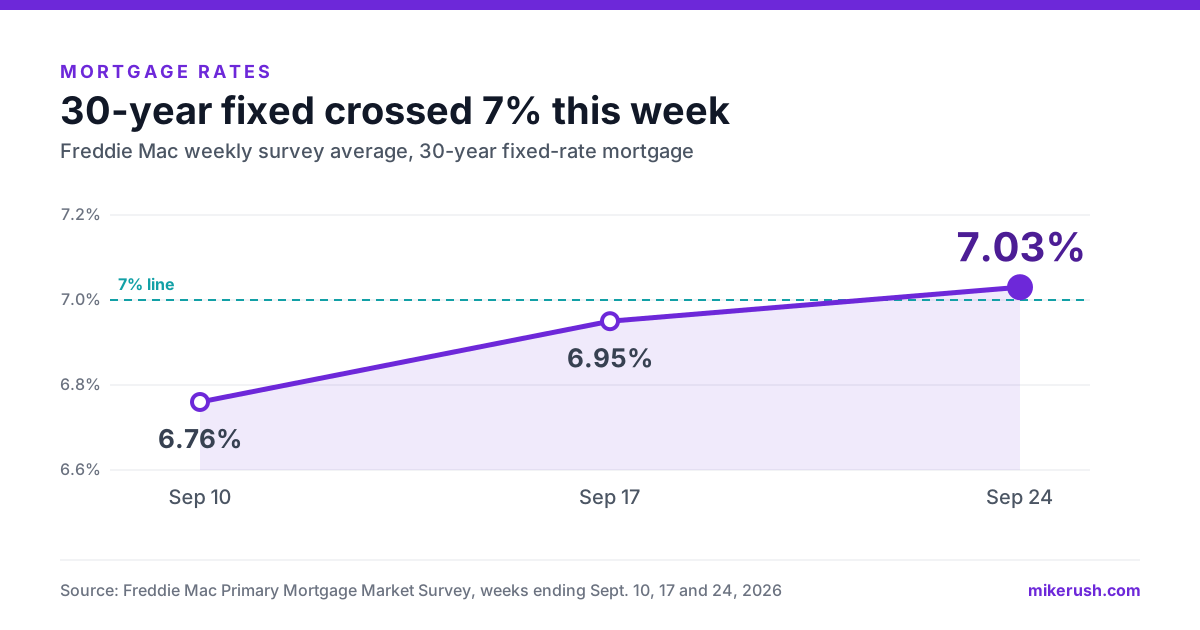
On a $500,000 loan, the move from 6.76% three weeks ago to this week’s official 7.03% adds about $90 a month. If the daily trackers’ 7.29% holds into next week’s survey, that swing grows to roughly $178 a month — about $2,140 a year. That’s not enough to change whether homeownership makes sense for most buyers, but it’s enough to matter for a monthly budget or a pre-approval that’s a few weeks stale.
The Denver read
Locally, the rate move is showing up in the numbers. The New Door Group’s Denver metro weekly update (September 19) put active listings at 13,179 — the highest level since August 2025 and up 1.3% year-over-year — while pending contracts were down 11.4% and showings down 14.8% compared to the same week last year. Median days on market edged up to 31 from 28. Their read, with local rates already quoted near 7.20% that week: “the leading edge of a slower market.”
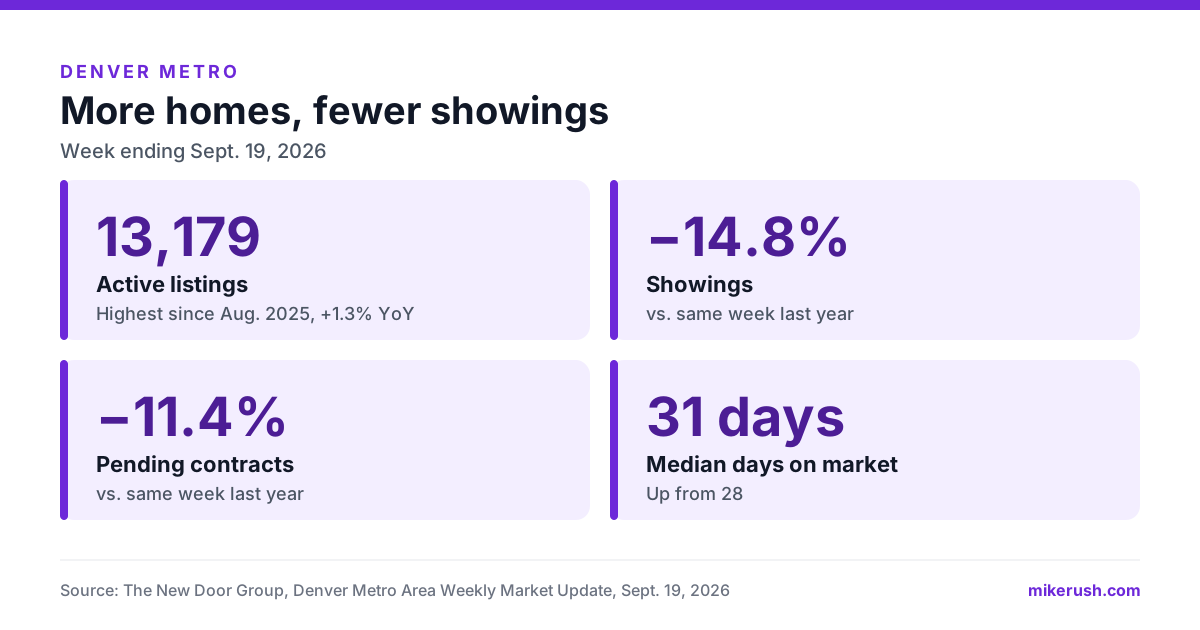
I’d put it a little differently: it’s a market where sellers need to price accurately from day one — reductions are already showing up on more than half of active Denver-metro listings — and where buyers who can move now have more room to negotiate than they’ve had in over a year.
What this means for you
If you’re a buyer, don’t let a headline rate scare you off a home you actually want — ask your lender about rate buydowns or an adjustable-rate option if the fixed rate doesn’t pencil out, and remember you can always refinance later if rates ease. If you’re a seller, this is exactly the environment where an accurate list price and a home that shows well matter more than ever; overpricing into a market with rising rates and more competition is the fastest way to end up chasing the market down.
Thinking about buying or selling with rates where they are? Let’s talk through what it actually means for your plan.
This is general market information, not financial, investment, or lending advice, and rates change daily — talk to your lender for a quote specific to you.
Sources
- Freddie Mac, Primary Mortgage Market Survey, weeks ending September 10, 17 and 24, 2026 (freddiemac.com/pmms)
- NPR, “Mortgage rates have just surpassed 7% for the first time in well over a year,” September 24, 2026
- CNN Newsource / ABC17 News, “10-year Treasury yield hits 5.1% for first time in 19 years,” September 23, 2026
- Mortgage News Daily, “Mortgage Rates Match Highest Level Since May 2024,” September 23, 2026
- NerdWallet, “Mortgage Rates Today, Thursday, September 24, 2026,” citing Zillow rate data
- Forbes Advisor, “Mortgage Rates Today: September 24, 2026 – 30-Year Rate Hits One-Year High”
- The New Door Group, “Denver Metro Area Weekly Market Update,” September 19, 2026